New study tracks the evolution of stone tools

New study tracks the evolution of stone tools

  • March 7, 2018
Table of Contents

New study tracks the evolution of stone tools

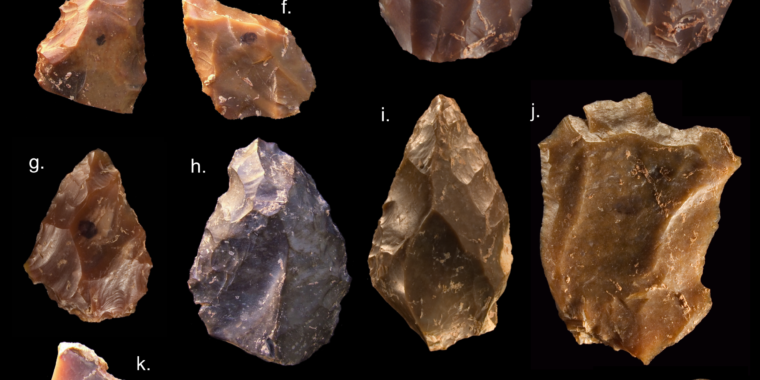
For at least 2.6 million years, humans and our ancestors have been making stone tools by chipping off flakes of material to produce sharp edges. We think of stone tools as very rudimentary technology, but producing a usable tool without wasting a lot of stone takes skill and knowledge. That’s why archaeologists tend to use the complexity of stone tools as a way to measure the cognitive skills of early humans and the complexity of their cultures and social interactions.

Source: arstechnica.com

Share :
comments powered by Disqus

Related Posts

First firing of air-breathing Electric Truster

First firing of air-breathing Electric Truster

In a world-first, an ESA-led team has built and fired an electric thruster to ingest scarce air molecules from the top of the atmosphere for propellant, opening the way to satellites flying in very low orbits for years on end.

Read More
A Preview of Bristlecone, Google’s New Quantum Processor

A Preview of Bristlecone, Google’s New Quantum Processor

The goal of the Google Quantum AI lab is to build a quantum computer that can be used to solve real-world problems. Our strategy is to explore near-term applications using systems that are forward compatible to a large-scale universal error-corrected quantum computer. In order for a quantum processor to be able to run algorithms beyond the scope of classical simulations, it requires not only a large number of qubits.

Read More
Surprise graphene discovery could unlock secrets of superconductivity

Surprise graphene discovery could unlock secrets of superconductivity

A sandwich of two graphene layers can conduct electrons without resistance if they are twisted at a ‘magic angle’’, physicists have discovered. The finding could prove to be a significant step in the decades-long search for room-temperature superconductors.

Read More