Open Sourcing the Hunt for Exoplanets

Open Sourcing the Hunt for Exoplanets

  • March 8, 2018
Table of Contents

Open Sourcing the Hunt for Exoplanets

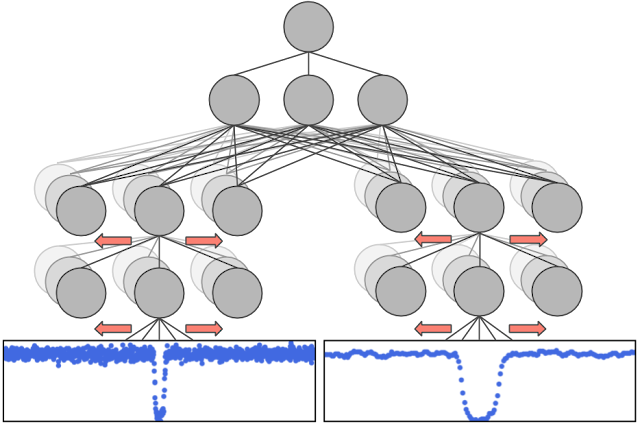
Recently, we discovered two exoplanets by training a neural network to analyze data from NASA’s Kepler space telescope and accurately identify the most promising planet signals. And while this was only an initial analysis of ~700 stars, we consider this a successful proof-of-concept for using machine learning to discover exoplanets, and more generally another example of using machine learning to make meaningful gains in a variety of scientific disciplines (e.g. healthcare, quantum chemistry, and fusion research)

Source: googleblog.com

Share :
comments powered by Disqus

Related Posts

Building a Next Word Predictor in Tensorflow

Building a Next Word Predictor in Tensorflow

Next Word Prediction or what is also called Language Modeling is the task of predicting what word comes next. It is one of the fundamental tasks of NLP and has many applications. You might be using it daily when you write texts or emails without realizing it.

Read More
Reptile: A Scalable Meta-Learning Algorithm

Reptile: A Scalable Meta-Learning Algorithm

We’ve developed a simple meta-learning algorithm called Reptile which works by repeatedly sampling a task, performing stochastic gradient descent on it, and updating the initial parameters towards the final parameters learned on that task. This method performs as well as MAML, a broadly applicable meta-learning algorithm, while being simpler to implement and more computationally efficient.

Read More