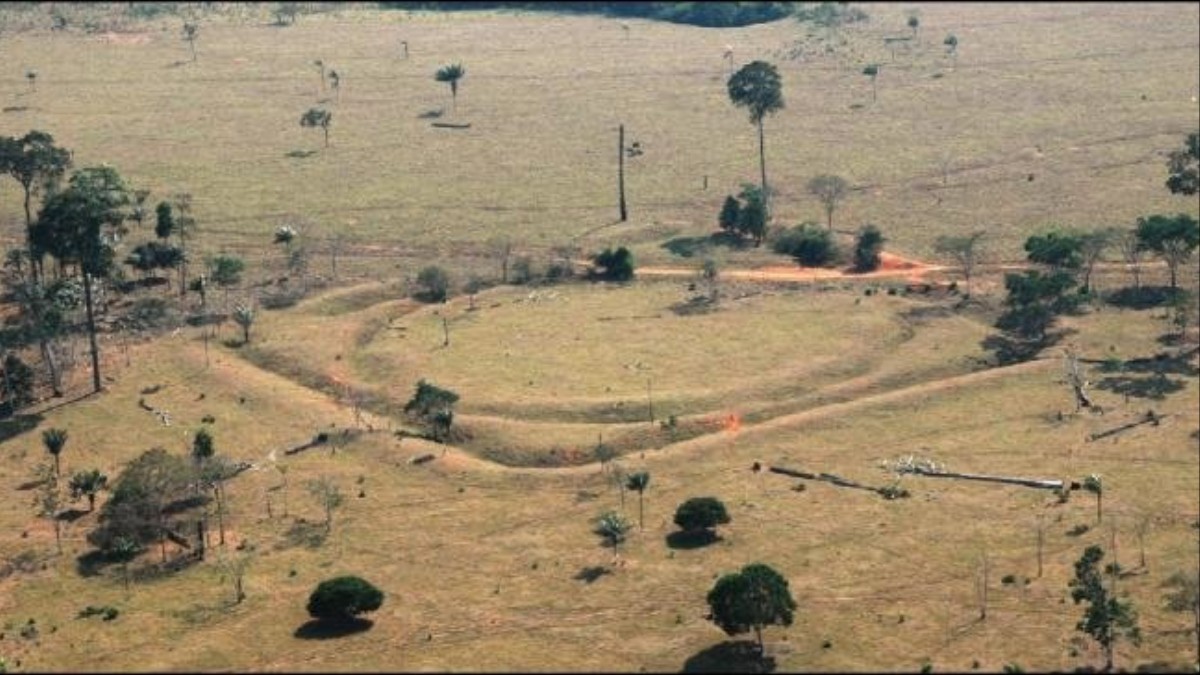
These Geometric Shapes Were Made By a Previously Unknown Civilization

These Geometric Shapes Were Made By a Previously Unknown Civilization

  • March 29, 2018
Table of Contents

These Geometric Shapes Were Made By a Previously Unknown Civilization

Now, a team of archaeologists and satellite imagery specialists have discovered the remains of a previously unknown civilization that flourished around 1250 to 1500 AD, just before the European colonization of the Americas. The find, which includes captivating images of geometric earthworks, is described in a paper published Tuesday in Nature Communications, led by University of Exeter archaeologist Jonas Gregorio de Souza.

Source: vice.com

Tags :
Share :
comments powered by Disqus

Related Posts

How Leo and Gertrude Stein Revolutionized the Art World

How Leo and Gertrude Stein Revolutionized the Art World

If Picasso and Matisse were rivals from almost the first moment each knew of the other’s existence, the contest was driven as much by those cheering from the sidelines as by their own considerable egos. It was Montmartre versus the Latin Quarter, the bande à Picasso versusthe Fauves, the dark voodoo of the Spaniard versus the Apollonian grace of the Frenchman. For the most part the competition was respectful, but it could occasionally devolve into childish stunts.

Read More
Digitising books as objects: The invisible made visible

Digitising books as objects: The invisible made visible

Technology has improved immensely since then and a lot of ‘ink’ has been spread across physical and virtual pages about the remit, the limitations and the advantages of what is offered to the public through the surrogates uploaded onto countless web portals. This piece is just another little drop into this ocean of ink to share some considerations built upon experience and from the perspective of a book conservator who sees, because of his professional background, the limitations of this, but also the exciting challenges to overcome them.

Read More
The shape of life

The shape of life

Last spring, the geobiologist Dominic Papineau and colleagues reported that fossilised microorganisms were identified in 3.77-4.28-billion-year-old iron-rich rock in Quebec: hematite tubes and filaments whose appearance is similar to microorganisms that today live in hydrothermal vents. Others dismissed their findings as ‘dubiofossils’, a term the geologist Hans Hofmann coined in 1972 to describe controversial fossils. ‘Fossils,’ Hofmann wrote, were proven biological; ‘pseudofossils’ resembled life but were inorganic; ‘dubiofossils’ (also known as Problematica or Miscellanea) were equivocal.

Read More