NASA likely to fly first deep space mission on less powerful rocket

NASA likely to fly first deep space mission on less powerful rocket

  • April 13, 2018
Table of Contents

NASA likely to fly first deep space mission on less powerful rocket

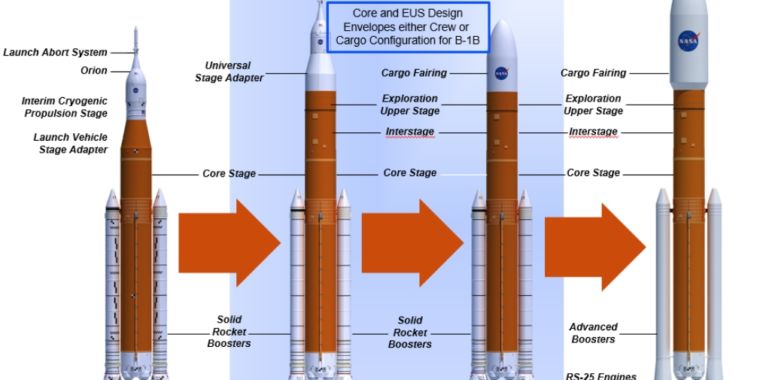
NASA will likely launch its first astronauts into deep space since the Apollo program on a less powerful version of its Space Launch System rocket than originally planned. Although it has not been officially announced, in recent weeks mission planners at the space agency have begun designing ‘Exploration Mission 2’ to be launched on the Block 1 version of the SLS rocket, which has the capability to lift 70 tons to low Earth orbit.

Source: arstechnica.com
Tags :
Share :
comments powered by Disqus

Related Posts

Breakthrough Announced in Dark Matter Detection Technology

Breakthrough Announced in Dark Matter Detection Technology

This week, the Axion Dark Matter Experiment (ADMX) unveiled a new result, published in the journal Physical Review Letters, that places it in a category of one: it is the world’s first and only experiment to have achieved the necessary sensitivity to “hear” the telltale signs of dark matter axions. This technological breakthrough is the result of more than 30 years of research and development, with the latest piece of the puzzle coming in the form of a quantum-enabled device that allows ADMX to listen for axions more closely than any experiment ever built.

Read More
Watch These Scientists Remotely Operate a Space Garbage Robot

Watch These Scientists Remotely Operate a Space Garbage Robot

Humans aren’t great at picking up their trash, a fact that is reinforced by the Great Pacific garbage patch and other massive dumps and landfills around the world. As it turns out, we are also taking our talent at producing rubbish into orbit with us. Since the advent of spaceflight in the 1950s, outer space has become congested with about 500,000 bits of spacecraft debris measuring larger than a marble, and 20,000 chunks larger than a softball, according to NASA.

Read More
Voyager 1 Fires Up Thrusters After 37 Years

Voyager 1 Fires Up Thrusters After 37 Years

Thethrusters aboard the Voyager 1 spacecraft just did what we thought was impossible. After 37 years of inactivity,NASA just received response from spacecraft 13 billion miles away, NASA said in a statement on its website. Voyager 1 is NASA’s farthest and fastest spacecraft.

Read More