A physical constant’s value shouldn’t depend on how you measure it

A physical constant’s value shouldn’t depend on how you measure it

  • April 14, 2018
Table of Contents

A physical constant’s value shouldn’t depend on how you measure it

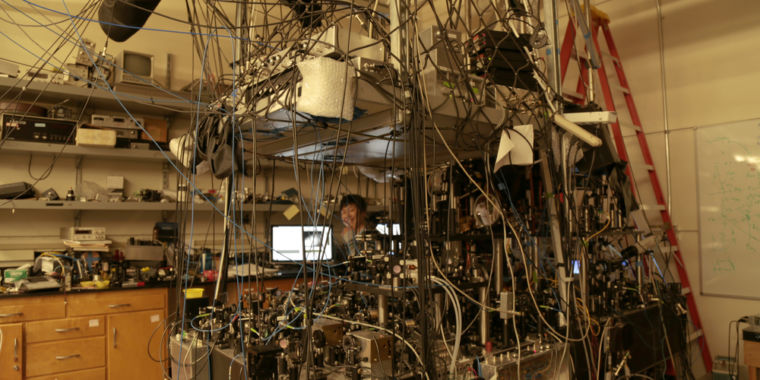
Measurements in physics are funny things. You’d hope that attempts to quantify some of the fundamental properties of the Universe would follow a simple pattern: they’d start with large error bars, but, over time, measuring technology improves and the error bars shrink. Ideally, the value would then remain nicely within the previous error.

Source: arstechnica.com
Tags :
Share :
comments powered by Disqus

Related Posts

DARPA Is Funding Time Crystal Research

DARPA Is Funding Time Crystal Research

You probably scratched your head last year if you read about time crystals, likely 2017’s most esoteric, widely covered popular science story. Even if you understood how they worked, you might not have known what use they could have. Time crystals, systems of atoms that maintain a periodic ticking behavior in the presence of an added electromagnetic pulse, have now piqued the interest of one well-funded government agency: the Department of Defense.

Read More
To Test Einstein’s Equations, Poke a Black Hole

To Test Einstein’s Equations, Poke a Black Hole

In November 1915, in a lecture before the Prussian Academy of Sciences, Albert Einstein described an idea that upended humanity’s view of the universe. Rather than accepting the geometry of space and time as fixed, Einstein explained that we actually inhabit a four-dimensional reality called space-time whose form fluctuates in response to matter and energy.

Read More