Scientists Make a Molecule by Manipulating Just Two Atoms

Scientists Make a Molecule by Manipulating Just Two Atoms

  • April 15, 2018
Table of Contents

Scientists Make a Molecule by Manipulating Just Two Atoms

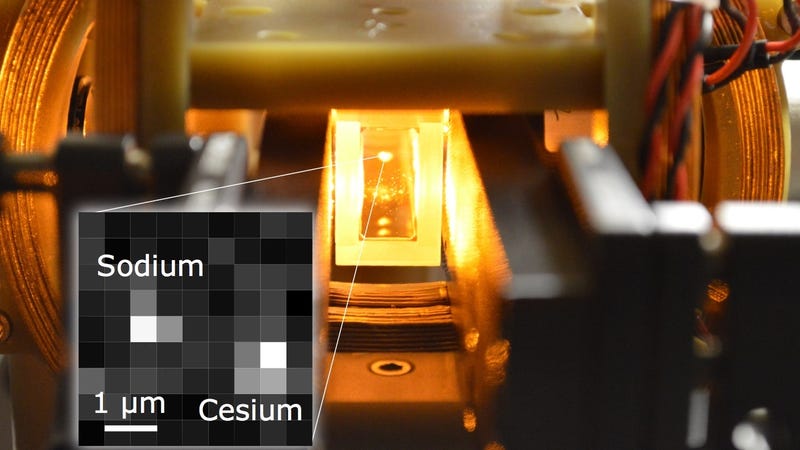
The physics here isn’t too hard to understand. Scientists have long been able to push around single atoms within clouds of many atoms. In this case, they used two optical “tweezers” at two specific wavelengths.

Basically, this is two differently colored lasers focused with a lens so that each laser controls one of two separate atoms, one cesium (Cs) and one sodium (Na) atom. They’re held still at near absolute zero in a vacuum. The researchers then overlap the beams to trap both atoms.

Source: gizmodo.com
Tags :
Share :
comments powered by Disqus

Related Posts

Dark Matter Is in Our DNA

Dark Matter Is in Our DNA

While some point to galaxy cluster work by Fritz Zwicky in the 1930s, dark matter was truly “discovered” in the 1970s by Vera Rubin, who was studying the rotation of spiral galaxies. Rubin found that galaxies were spinning too fast for the matter we could see in them, yet they weren’t flying apart. Rubin’s work left astronomers with a choice: Either our laws of gravity were wrong, or there was something else out there pulling on the galaxy’s stars and speeding them up while keeping them together.

Read More
To Test Einstein’s Equations, Poke a Black Hole

To Test Einstein’s Equations, Poke a Black Hole

In November 1915, in a lecture before the Prussian Academy of Sciences, Albert Einstein described an idea that upended humanity’s view of the universe. Rather than accepting the geometry of space and time as fixed, Einstein explained that we actually inhabit a four-dimensional reality called space-time whose form fluctuates in response to matter and energy.

Read More
DARPA Is Funding Time Crystal Research

DARPA Is Funding Time Crystal Research

You probably scratched your head last year if you read about time crystals, likely 2017’s most esoteric, widely covered popular science story. Even if you understood how they worked, you might not have known what use they could have. Time crystals, systems of atoms that maintain a periodic ticking behavior in the presence of an added electromagnetic pulse, have now piqued the interest of one well-funded government agency: the Department of Defense.

Read More