20 Entangled Qubits Bring the Quantum Computer Closer

20 Entangled Qubits Bring the Quantum Computer Closer

  • April 17, 2018
Table of Contents

20 Entangled Qubits Bring the Quantum Computer Closer

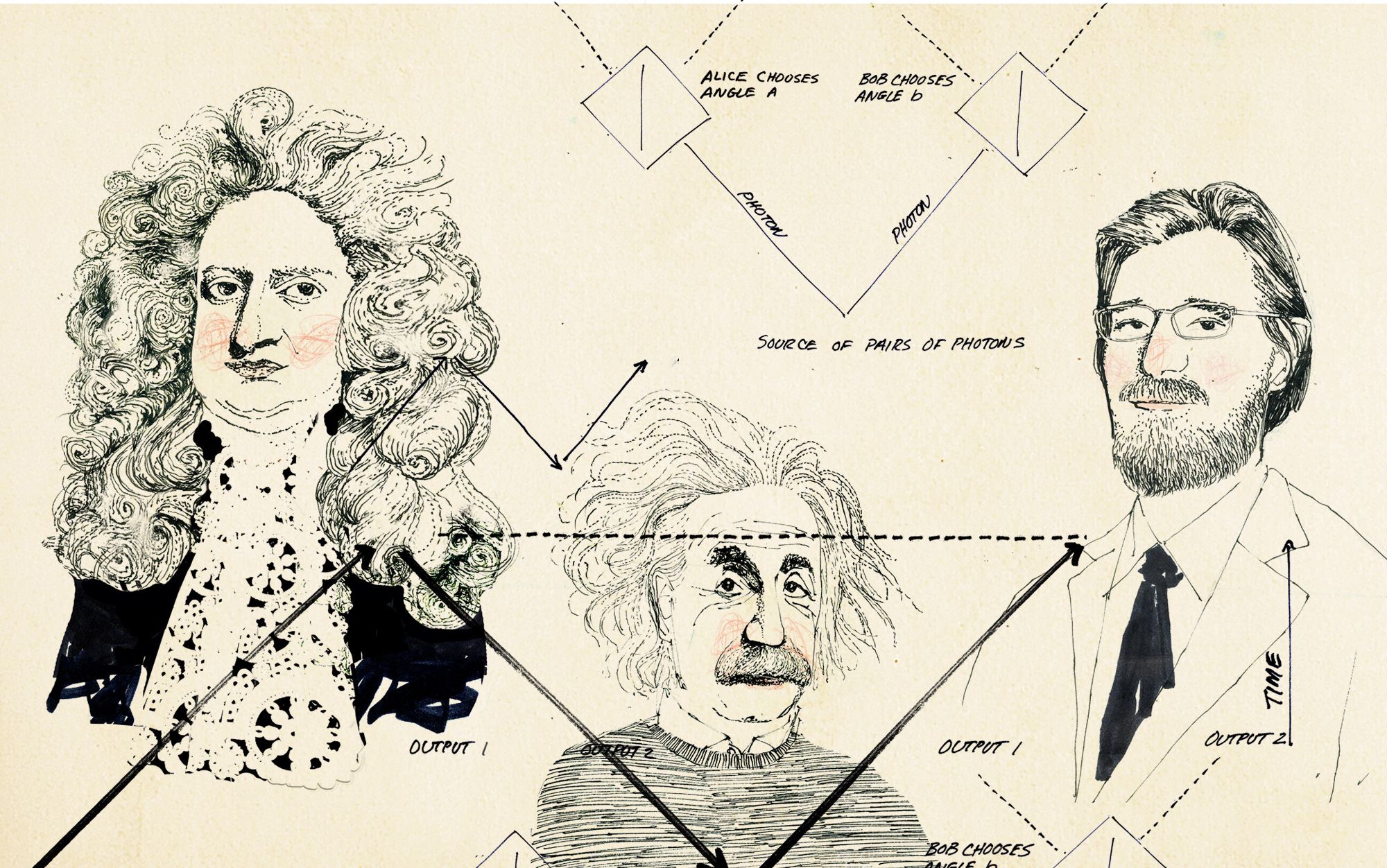
In 1981, Richard Feynman suggested that a quantum computer might be able to simulate the evolution of quantum systems much better than classical computers. Except for several proof-of-principle experiments, no working quantum computer has yet been built.

Source: ieee.org

Tags :
Share :
comments powered by Disqus

Related Posts

Can retrocausality solve the puzzle of action-at-a-distance?

Can retrocausality solve the puzzle of action-at-a-distance?

Einstein’s objections to quantum mechanics began very early. Schrödinger’s version of the theory introduced a new mathematical entity, the wave function, which seemed to allow the position of an unmeasured particle to be spread out across an arbitrarily large region of space. When the particle’s position was measured, the wave function was said to ‘collapse’, suddenly becoming localised where the particle was detected.

Read More
Google Unveils 72-Qubit Quantum Computer With Low Error Rates

Google Unveils 72-Qubit Quantum Computer With Low Error Rates

If a quantum processor can be operated with low enough error, it would be able to outperform a classical supercomputer on a well-defined computer science problem, an achievement known as quantum supremacy. These random circuits must be large in both number of qubits as well as computational length (depth). Although no one has achieved this goal yet, we calculate quantum supremacy can be comfortably demonstrated with 49 qubits, a circuit depth exceeding 40, and a two-qubit error below 0.5%.

Read More