Measuring the Intrinsic Dimension of Objective Landscapes

Measuring the Intrinsic Dimension of Objective Landscapes

  • April 27, 2018
Table of Contents

Measuring the Intrinsic Dimension of Objective Landscapes

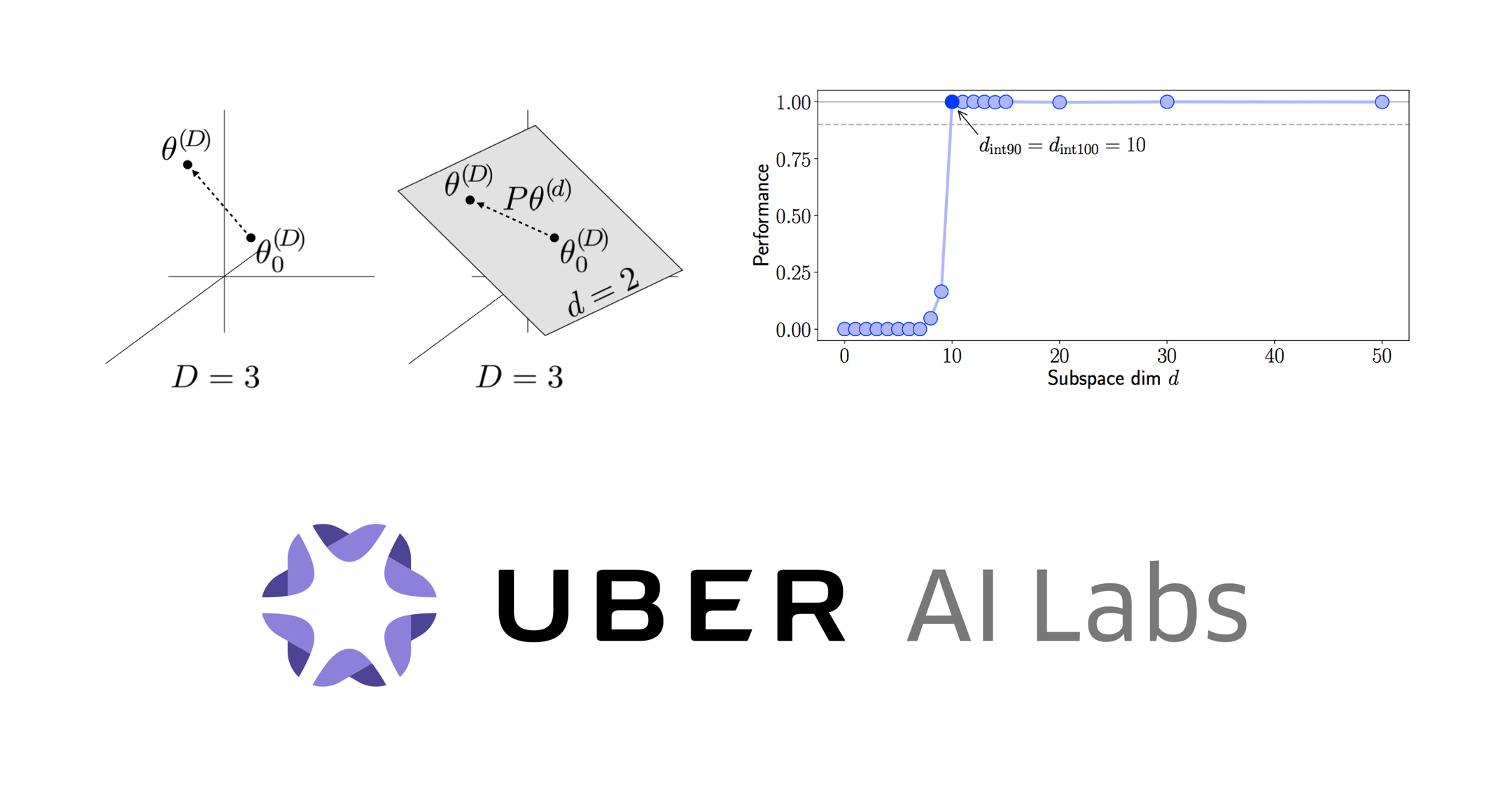
In our paper, Measuring the Intrinsic Dimension of Objective Landscapes, to be presented at ICLR 2018, we contribute to this ongoing effort by developing a simple way of measuring a fundamental network property known as intrinsic dimension. In the paper, we develop intrinsic dimension as a quantification of the complexity of a model in a manner decoupled from its raw parameter count, and we provide a simple way of measuring this dimension using random projections. We find that many problems have smaller intrinsic dimension than one might suspect.

By using intrinsic dimension to compare across problem domains, we measure, for example, that solving the inverted pendulum problem is about 100 times easier than classifying digits from MNIST, and playing Atari Pong from pixels is about as hard as classifying CIFAR-10.

Source: uber.com

Tags :
Share :
comments powered by Disqus

Related Posts

United Kingdom Plans $1.3 Billion Artificial Intelligence Push

United Kingdom Plans $1.3 Billion Artificial Intelligence Push

The U.K. government said Thursday that part of its multi-year AI investment–about £300 million, or more than $400 million–would come from U.K.-based corporations and investment firms and those located outside the country.

Read More
Why data scientists should start learning Swift

Why data scientists should start learning Swift

One week into my first year physics course at the University of Michigan, a professor assigned a problem set that required simulating some many-body system. It was due Friday. That was the week I learned my first programming language, Matlab.

Read More
Introduction to Decision Tree Learning

Introduction to Decision Tree Learning

From Kaggle to classrooms, one of the first lessons in machine learning involves decision trees. The reason for the focus on decision trees is that they aren’t very mathematics heavy compared to other ML approaches, and at the same time, they provide reasonable accuracy on classification problems.

Read More