Custom deep learning loss functions with Keras for R

Custom deep learning loss functions with Keras for R

  • May 12, 2018
Table of Contents

Custom deep learning loss functions with Keras for R

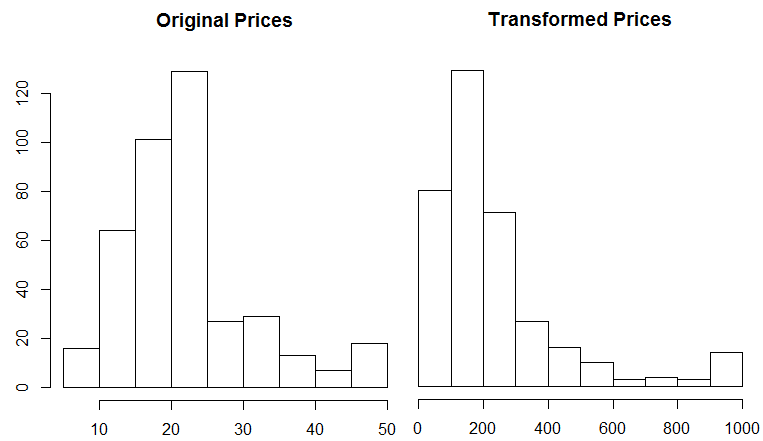
I recently started reading “Deep Learning with R”, and I’ve been really impressed with the support that R has for digging into deep learning. One of the use cases presented in the book is predicting prices for homes in Boston, which is an interesting problem because homes can have such wide variations in values. This is a machine learning problem that is probably best suited for classical approaches, such as XGBoost, because the data set is structured rather than perceptual data.

However, it’s also a data set where deep learning provides a really useful capability, which is the ease of writing new loss functions that may improve the performance of predictive models. The goal of this post is to show how deep learning can potentially be used to improve shallow learning problems by using custom loss functions.

Source: towardsdatascience.com

Share :
comments powered by Disqus

Related Posts

Delivery Robots Will Rely on Human Kindness and Labor

Delivery Robots Will Rely on Human Kindness and Labor

In April, Starship Technologies announced that it is going to launch “robot delivery services for campuses.” Its goal is to deploy at least 1,000 delivery robots to “corporate and academic campuses in Europe and the U.S.” within the next year. It’s the latest in a long list of automated delivery schemes from a tech companies big and small.

Read More
Artificial Neural Nets Grow Brainlike Navigation Cells

Artificial Neural Nets Grow Brainlike Navigation Cells

Having the sense to take a shortcut, the most direct route from point A to point B, doesn’t sound like a very impressive test of intelligence. Yet according to a new report appearing today in Nature, in which researchers describe the performance of their new navigational artificial intelligence, the system’s ability to explore complex simulated environments and find the shortest route to a goal put it in a class previously reserved for humans and other living things. The surprising key to the system’s performance was that while learning how to navigate, the neural net spontaneously developed the equivalent of “grid cells,” sets of brain cells that enable at least some mammals to track their location in space.

Read More
Intel Starts R&D Effort in Probabilistic Computing for AI

Intel Starts R&D Effort in Probabilistic Computing for AI

Intel announced today that it is forming a strategic research alliance to take artificial intelligence to the next level. Autonomous systems don’t have good enough ways to respond to the uncertainties of the real world, and they don’t have a good enough way to understand how the uncertainties of their sensors should factor into the decisions they need to make. According to Intel CTO Mike Mayberry the answer is “probabilistic computing”, which he says could be AI’s next wave.

Read More