An Interesting New Pattern in the Prime Numbers: Parallax Compression

An Interesting New Pattern in the Prime Numbers: Parallax Compression

  • May 21, 2018
Table of Contents

An Interesting New Pattern in the Prime Numbers: Parallax Compression

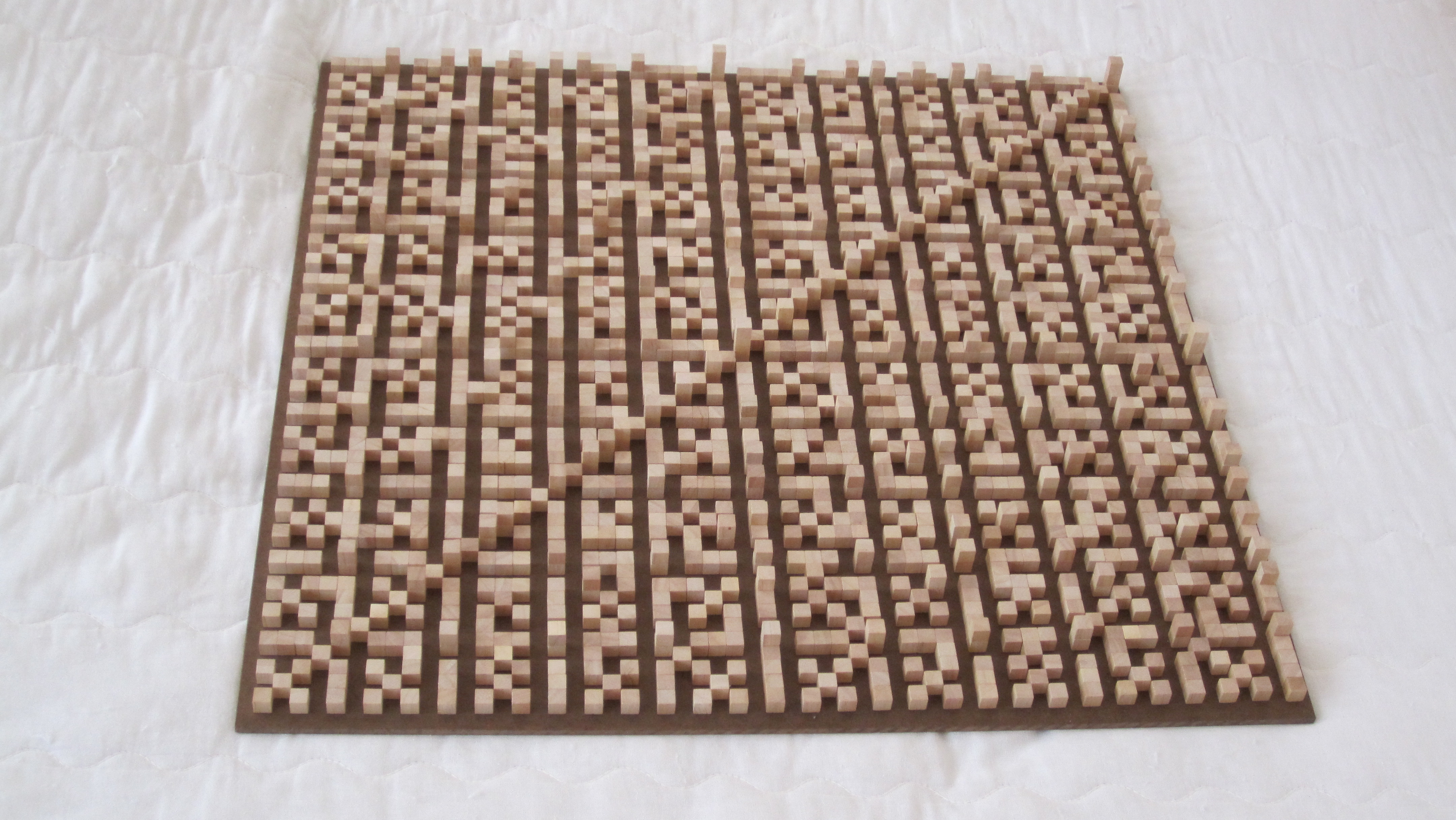
Shaun explained that he had developed a new algorithm (he calls it “Parallax Compression”) for wrapping the primes on a plane, and visualizing their distribution, inspired by the Ulam Spiral. Shaun’s algorithm revealed an interesting non-random, fractal-like pattern in the distribution of primes, that to our knowledge, had not been found before. It made it possible to easily see where there are regions of prime and non-prime numbers, anywhere on the number line, at any level of scale.

What was most interesting was how it was strikingly self-similar at different settings of the key value, n, which determines the number of integers per cell, and the number of rows in the visualization. Shaun’s algorithm revealed an interesting non-random, fractal-like pattern in the distribution of primes, that to our knowledge, had not been found before. It made it possible to easily see where there are regions of prime and non-prime numbers, anywhere on the number line, at any level of scale.

What was most interesting was how it was strikingly self-similar at different settings of the key value, n, which determines the number of integers per cell, and the number of rows in the visualization. When one looks at a visualization of this pattern, it appears reminiscent of runes, Mayan glyphs, Amazonian tribal imagery, tapestries, and hieroglyphics. If you look at it for a moment or two you will see there are several levels of nested geometric shapes within it that appear to have a kind of fractal symmetry:

Source: novaspivack.com
Tags :
Share :
comments powered by Disqus

Related Posts

Algorithms tutorial for beginners

Algorithms tutorial for beginners

As a developer, you have the power to change the world! You can write programs that enable new technologies. You might work in software to find an earlier diagnosis of diseases.

Read More
Lost in Math: Beauty != truth

Lost in Math: Beauty != truth

In Lost in Math, Hossenfelder delves briefly into the history of particle physics in order to explain the success of the Standard Model of particles and forces. She touches on why we’ve not had any unexplainable data from experimental particle physics for the last 50 years. She then takes us on a tour of the data that make us think we should be looking for physics that is not explained by the Standard Model—dark matter, dark energy, and cosmic inflation.

Read More

A Chemist Shines Light on a Surprising Prime Number Pattern

About a year ago, the theoretical chemist Salvatore Torquato met with the number theorist Matthew de Courcy-Ireland to explain that he had done something highly unorthodox with prime numbers, those positive integers that are divisible only by 1 and themselves. Torquato told de Courcy-Ireland, a final-year graduate student at Princeton who had been recommended by another mathematician, that a year before, on a hunch, he had performed diffraction on sequences of prime numbers. Hoping to highlight the elusive order in the distribution of the primes, he and his student Ge Zhang had modeled them as a one-dimensional sequence of particles — essentially, little spheres that can scatter light.

Read More