Real Time Facial Expression Recognition

Real Time Facial Expression Recognition

  • November 14, 2018
Table of Contents

Real Time Facial Expression Recognition

Computer animated agents and robots bring new dimension in human computer interaction which makes it vital as how computers can affect our social life in day-to-day activities. Face to face communication is a real-time process operating at a time scale in the order of milliseconds. The level of uncertainty at this time scale is considerable, making it necessary for humans and machines to rely on sensory rich perceptual primitives rather than slow symbolic inference processes.

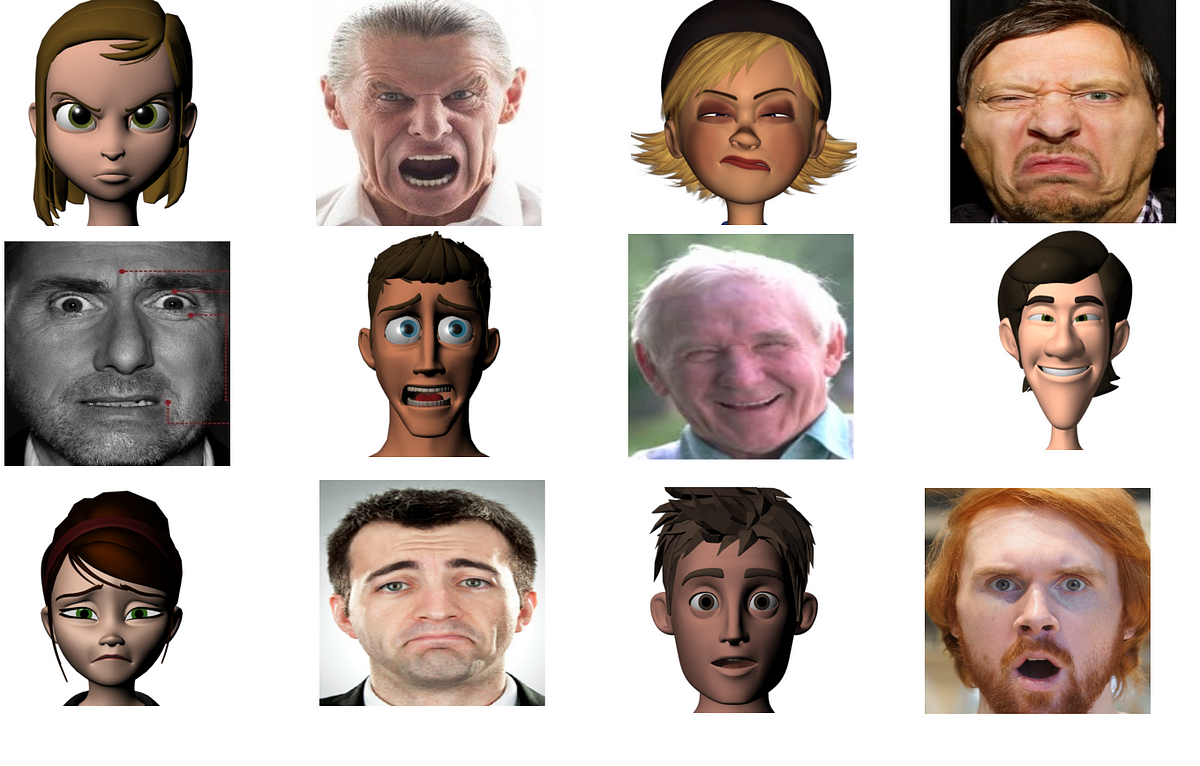
In this project we are presenting the real time facial expression recognition of seven most basic human expressions: ANGER, DISGUST, FEAR, HAPPY, NEUTRAL, SAD, SURPRISE. This model can be used for prediction of expressions of both still images and real time video. However, in both the cases we have to provide image to the model.

In case of real time video the image should be taken at any frame in time and feed it to the model for prediction of expression. The system automatically detects the face using HAAR cascade then its crops it and resize the image to a specific size and give it to the model for prediction. The model will generate seven probability values corresponding to seven expressions.

The highest probability value to the corresponding expression will be the predicted expression for that image. However, our goal here is to predict the human expressions, but we have trained our model on both human and animated images. Since, we had only approx 1500 human images which are very less to make a good model, so we took approximately 9000 animated images and leverage those animated images for training the model and ultimately do the prediction of expressions on human images.

Source: medium.com

Tags :
Share :
comments powered by Disqus

Related Posts

Horizon: An open-source reinforcement learning platform

Horizon: An open-source reinforcement learning platform

Horizon is the first open source end-to-end platform that uses applied reinforcement learning (RL) to optimize systems in large-scale production environments. The workflows and algorithms included in this release were built on open frameworks — PyTorch 1.0, Caffe2, and Spark — making Horizon accessible to anyone using RL at scale. We’ve put Horizon to work internally over the past year in a wide range of applications, including helping to personalize M suggestions, delivering more meaningful notifications, and optimizing streaming video quality.

Read More
Tensorflow 2.0: models migration and new design

Tensorflow 2.0: models migration and new design

Tensorflow 2.0 will be a major milestone for the most popular machine learning framework: lots of changes are coming, and all with the aim of making ML accessible to everyone. These changes, however, requires for the old users to completely re-learn how to use the framework: this article describes all the (known) differences between the 1.x and 2.x version, focusing on the change of mindset required and highlighting the pros and cons of the new and implementations. This article can be a good starting point also for the novice: start thinking in the Tensorflow 2.0 way right now, so you don’t have to re-learn a new framework (unless until Tensorflow 3.0 will be released).

Read More
EPO Issues First Guidelines on AI Patents

EPO Issues First Guidelines on AI Patents

The European Patent Office (EPO) has issued official guidelines on the patenting of artificial intelligence and machine learning technologies. The guidelines became valid on November 1st, 2018. When determining whether the claimed subject-matter satisfies this condition, the guidelines note that expressions such as “support vector machine,” “reasoning engine” or “neural network” may not qualify, as these are regarded as terms for mathematical methods which do not have a unique technical character of their own.

Read More