FastMRI open source tools from Facebook and NYU

FastMRI open source tools from Facebook and NYU

  • November 27, 2018
Table of Contents

FastMRI open source tools from Facebook and NYU

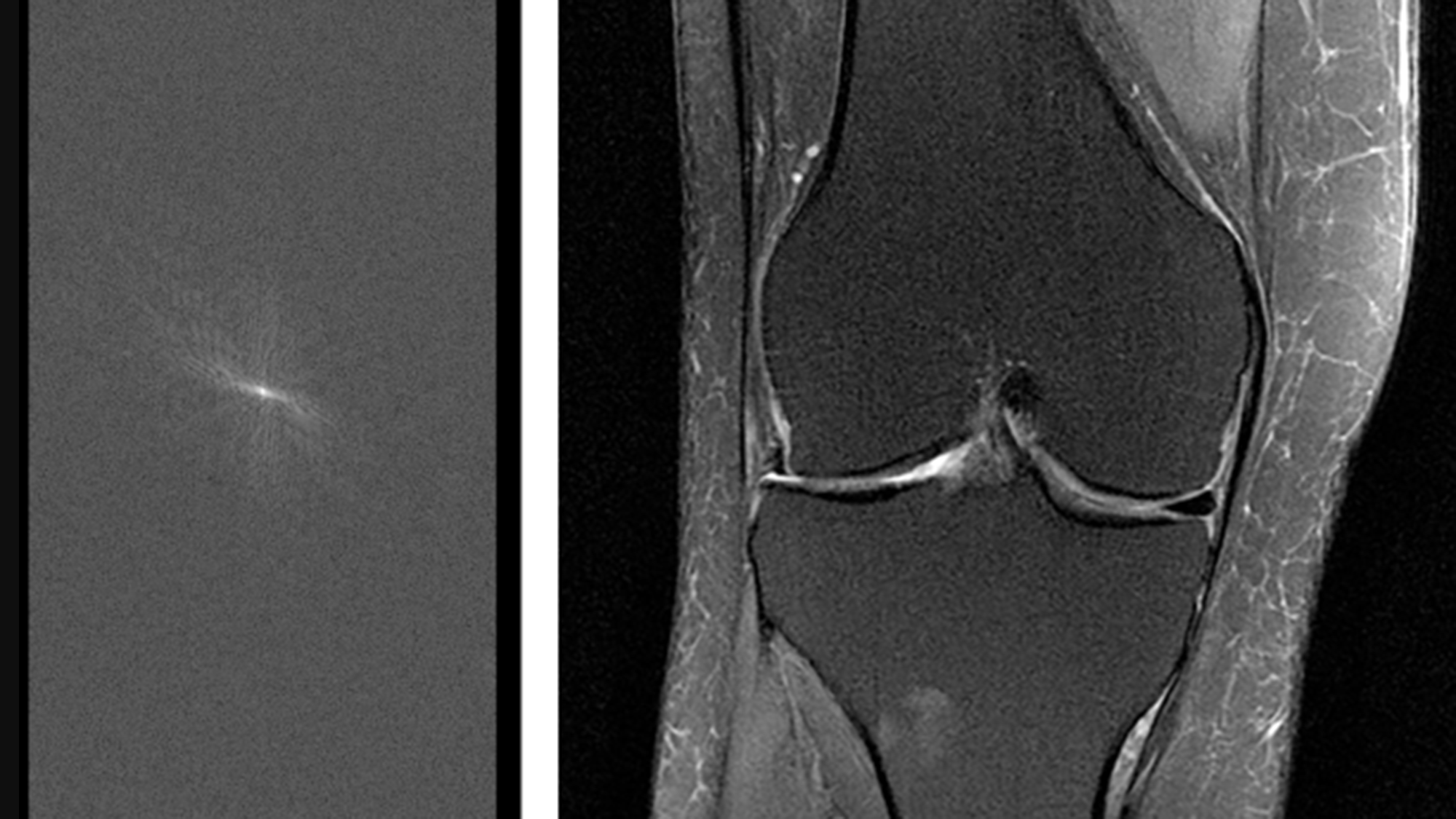
Facebook AI Research (FAIR) and NYU School of Medicine’s Center for Advanced Imaging Innovation and Research (CAI²R) are sharing new open source tools and data as part of fastMRI, a joint research project to spur development of AI systems to speed MRI scans by up to 10x. Today’s releases include new AI models and baselines for this task(as described in our paper here). It also includes the first large-scale MRI data set of its kind, which can serve as a benchmark for future research.

By sharing a standardized set of AI tools and MRI data, as well as hosting a leaderboard where research teams can compare their results, we aim to help improve diagnostic imaging technology, and eventually increase patients’ access to a powerful and sometimes life-saving technology. With new AI techniques, we hope to generate scans that require much less measurement data to produce the image detail necessary for accurate detection of abnormalities. Sharing this suite of resources reflects the fastMRI mission, which is to engage the larger community of AI and medical imaging researchers rather than to develop proprietary methods for accelerating MR imaging.

Improved accuracy with increased training data: This chart shows the impact of four sizes of training sets on the performance of our baseline ML models, which used a U-net neural network architecture. The more MRI cases the system was trained on, the lower its loss was, indicating that its image predictions were more likely to be accurate.

Source: fb.com
Tags :
Share :
comments powered by Disqus

Related Posts

Real Time Facial Expression Recognition

Real Time Facial Expression Recognition

Computer animated agents and robots bring new dimension in human computer interaction which makes it vital as how computers can affect our social life in day-to-day activities. Face to face communication is a real-time process operating at a time scale in the order of milliseconds. The level of uncertainty at this time scale is considerable, making it necessary for humans and machines to rely on sensory rich perceptual primitives rather than slow symbolic inference processes.

Read More
Humanizing Customer Complaints using NLP Algorithms

Humanizing Customer Complaints using NLP Algorithms

Last Christmas, I went through the most frustrating experience as a consumer. I was doing some last minute holiday shopping and after standing in a long line, I finally reached the blessed register only to find out that my debit card was blocked. I could sense the old lady at the register judging me with her narrowed eyes.

Read More
A Google Brain engineer’s guide to entering AI

A Google Brain engineer’s guide to entering AI

Note that this guide was written in November 2018 to complement an in-depth conversation on the 80,000 Hours Podcast with Catherine Olsson and Daniel Ziegler on how to transition from computer science and software engineering in general into ML engineering, with a focus on alignment and safety. If you like this guide, we’d strongly encourage you to check out the podcast episode where we discuss some of the instructions here, and other relevant advice. Technical AI safety is a multifaceted area of research, with many sub-questions in areas such as reward learning, robustness, and interpretability.

Read More