Server Name Indication (SNI) Support Now in Ambassador

Server Name Indication (SNI) Support Now in Ambassador

  • January 27, 2019
Table of Contents

Server Name Indication (SNI) Support Now in Ambassador

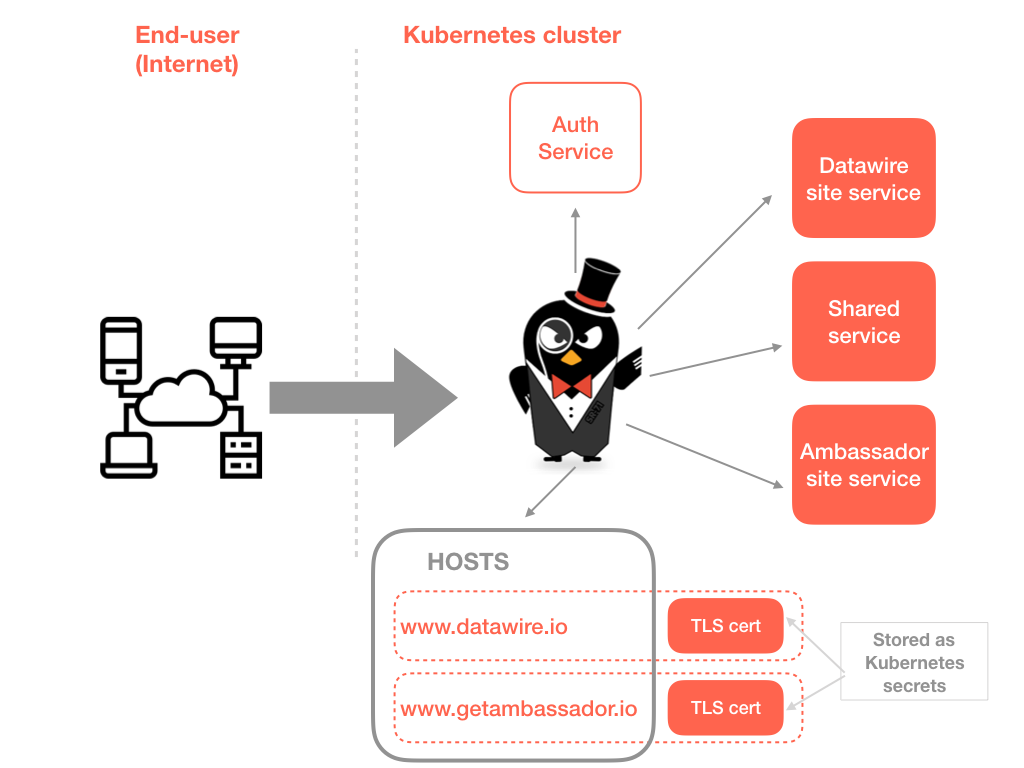
We’ve discussed many interesting use cases for SNI support within the edge proxy/gateway with both open source and commercially supported users of Ambassador. In a nutshell (and with thanks to Wikipedia), SNI is an extension to the TLS protocol which allows a client to indicate which hostname it is attempting to connect to at the start of the TCP handshaking process. This allows the server to present multiple certificates on the same IP address and TCP port number, which in turn enables the serving of multiple secure websites or API services without requiring all those sites to use the same certificate.

For those of you who have configured edge proxies and API gateways in the past, SNI is the conceptual equivalent to HTTP/1.1 name-based virtual hosting, but for HTTPS. Many people are running Kubernetes clusters that offer multiple backend services to end-users, and frequently they want to serve secure traffic while presenting multiple hostnames as, for example, this allows the easy differentiation of services (e.g. www.datawire.io and api.dw.io) on offer, and supports the exposure of multiple in-house (web addressable) brands that share backend services from a single cluster (e.g. www.fashion-brand-one.com and www.fashion-brand-two.com). The Ambassador SNI documentation provides a step-by-step guide to configuration, but I’ve also provided a summary here.

Source: getambassador.io

Share :
comments powered by Disqus

Related Posts

APIServer dry-run and kubectl diff

APIServer dry-run and kubectl diff

Declarative configuration management, also known as configuration-as-code, is one of the key strengths of Kubernetes. It allows users to commit the desired state of the cluster, and to keep track of the different versions, improve auditing and automation through CI/CD pipelines. The Apply working-group is working on fixing some of the gaps, and is happy to announce that Kubernetes 1.13 promoted server-side dry-run and kubectl diff to beta.

Read More
CVE-2018-18264 Privilege escalation through Kubernetes dashboard

CVE-2018-18264 Privilege escalation through Kubernetes dashboard

A recently disclosed vulnerability in Kubernetes dashboard (CVE-2018-18264) exposes secrets to unauthenticated users. In this blog post we’ll explore some key takeaways regarding monitoring privilege escalation on Kubernetes. The Kubernetes dashboard is a web based user interface that allows users to manage applications and resources within the cluster.

Read More
Combining Federation V2 and Istio Multicluster

Combining Federation V2 and Istio Multicluster

In a previous post, we saw how to leverage Istio Multicluster to deploy an application (bookinfo) on multiple Red Hat OpenShift clusters and apply mesh policies on all of the deployed services. We also saw that the deployment process was relatively complex. In this post we are going to see how Federation V2 can help simplify the process of deploying an application to multiple clusters.

Read More