Embodied Question Answering: A goal-driven approach to autonomous agents

Embodied Question Answering: A goal-driven approach to autonomous agents

  • May 4, 2018
Table of Contents

Embodied Question Answering: A goal-driven approach to autonomous agents

Facebook AI Research (FAIR) has developed a collection of virtual environments for training and testing autonomous agents, as well as novel AI agents that learn to intelligently explore those environments. To test this goal-driven approach, FAIR are collaborating Georgia Tech on a multistep AI task called Embodied Question Answering, or EmbodiedQA.

Source: facebook.com
Tags :
Share :
comments powered by Disqus

Related Posts

DeepMind papers at ICLR 2018

DeepMind papers at ICLR 2018

Between 30 April and 03 May, hundreds of researchers will gather in Vancouver, Canada, for the Sixth International Conference on Learning Representations. Here you will find details of all DeepMind’s accepted papers.

Read More
What tech calls “AI” isn’t really AI

What tech calls “AI” isn’t really AI

First, the problem itself is poorly defined: what do you mean by intelligence? Nature, with all her blind hideous strength, endless experimentation and wild wastes of infinite time, has only managed the trick once (by our narrow definition), with one species of tree-ape on a rolling green world. Even if you believe there’s intelligent biological life elsewhere, the stats aren’t promising.

Read More
Measuring the Intrinsic Dimension of Objective Landscapes

Measuring the Intrinsic Dimension of Objective Landscapes

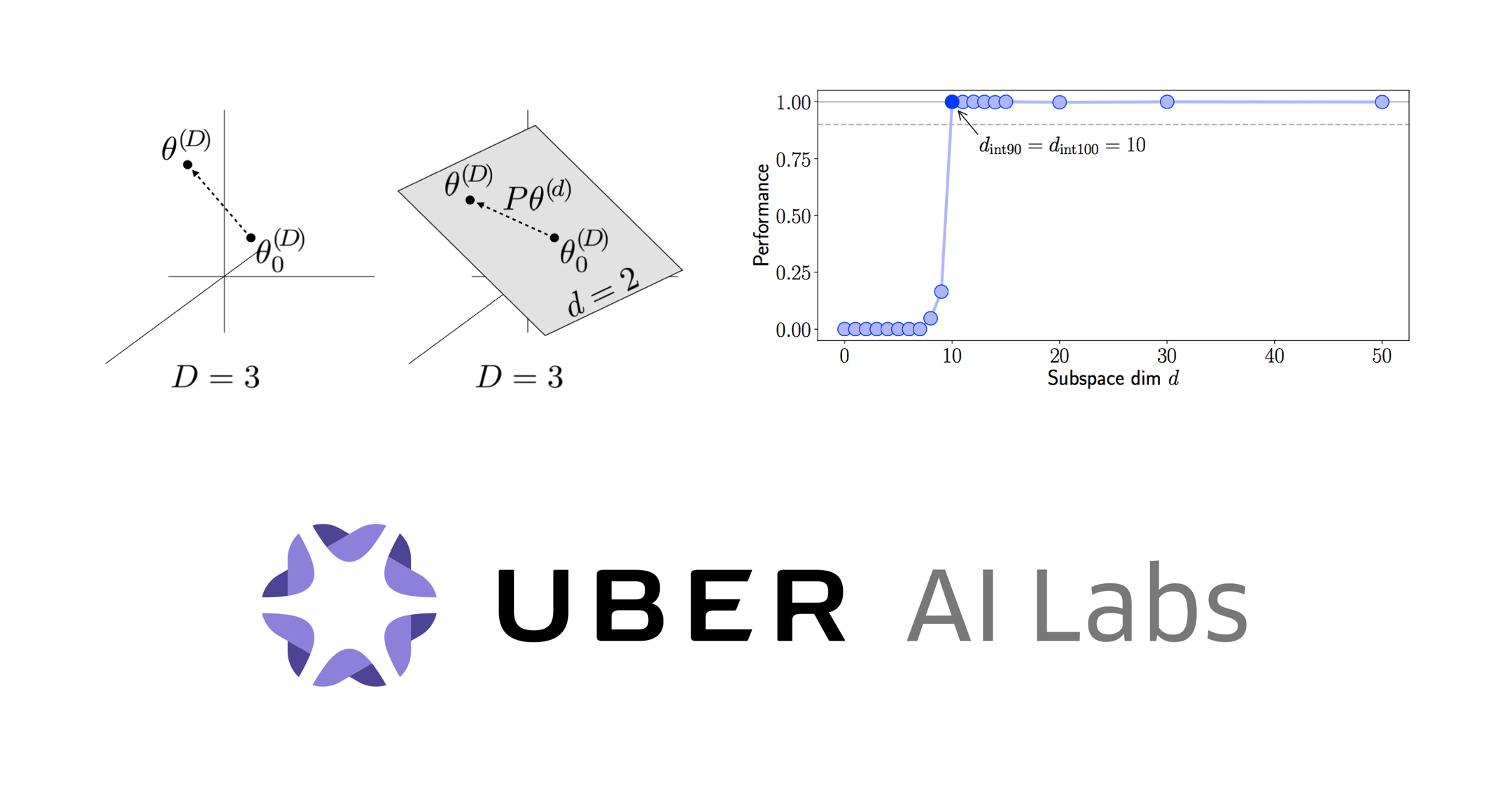
In our paper, Measuring the Intrinsic Dimension of Objective Landscapes, to be presented at ICLR 2018, we contribute to this ongoing effort by developing a simple way of measuring a fundamental network property known as intrinsic dimension. In the paper, we develop intrinsic dimension as a quantification of the complexity of a model in a manner decoupled from its raw parameter count, and we provide a simple way of measuring this dimension using random projections. We find that many problems have smaller intrinsic dimension than one might suspect.

Read More