Transfer Learning
Table of Contents
Transfer Learning is the reuse of a pre-trained model on a new problem. It is currently very popular in the field of Deep Learning because it enables you to train Deep Neural Networks with comparatively little data. This is very useful since most real-world problems typically do not have millions of labeled data points to train such complex models.
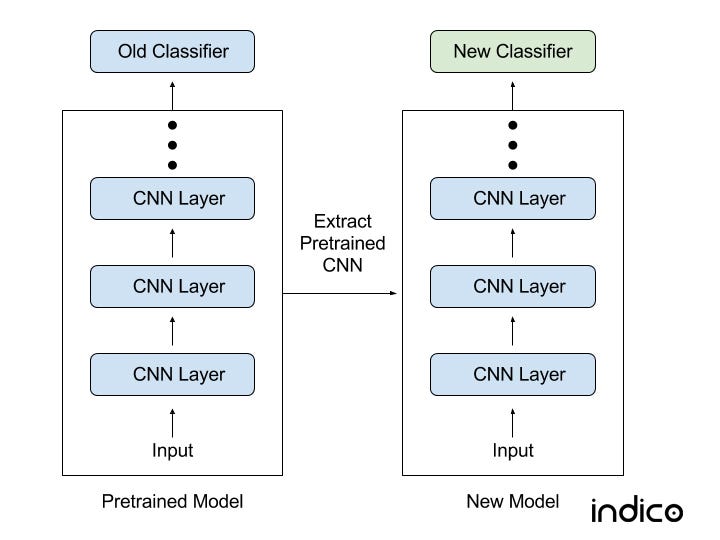
This blog post is intended to give you an overview of what Transfer Learning is, how it works, why you should use it and when you can use it. It will introduce you to the different approaches of Transfer Learning and provide you with some resources on already pre-trained models. In Transfer Learning, the knowledge of an already trained Machine Learning model is applied to a different but related problem.
For example, if you trained a simple classifier to predict whether an image contains a backpack, you could use the knowledge that the model gained during its training to recognize other objects like sunglasses. With transfer learning, we basically try to exploit what has been learned in one task to improve generalization in another. We transfer the weights that a Network has learned at Task A to a new Task B.
The general idea is to use knowledge, that a model has learned from a task where a lot of labeled training data is available, in a new task where we don’t have a lot of data. Instead of starting the learning process from scratch, you start from patterns that have been learned from solving a related task.
Source: towardsdatascience.com