Ambassador: Building a Control Plane for an Envoy-Powered API Gateway on Kubernetes

Ambassador: Building a Control Plane for an Envoy-Powered API Gateway on Kubernetes

  • February 8, 2019
Table of Contents

Ambassador: Building a Control Plane for an Envoy-Powered API Gateway on Kubernetes

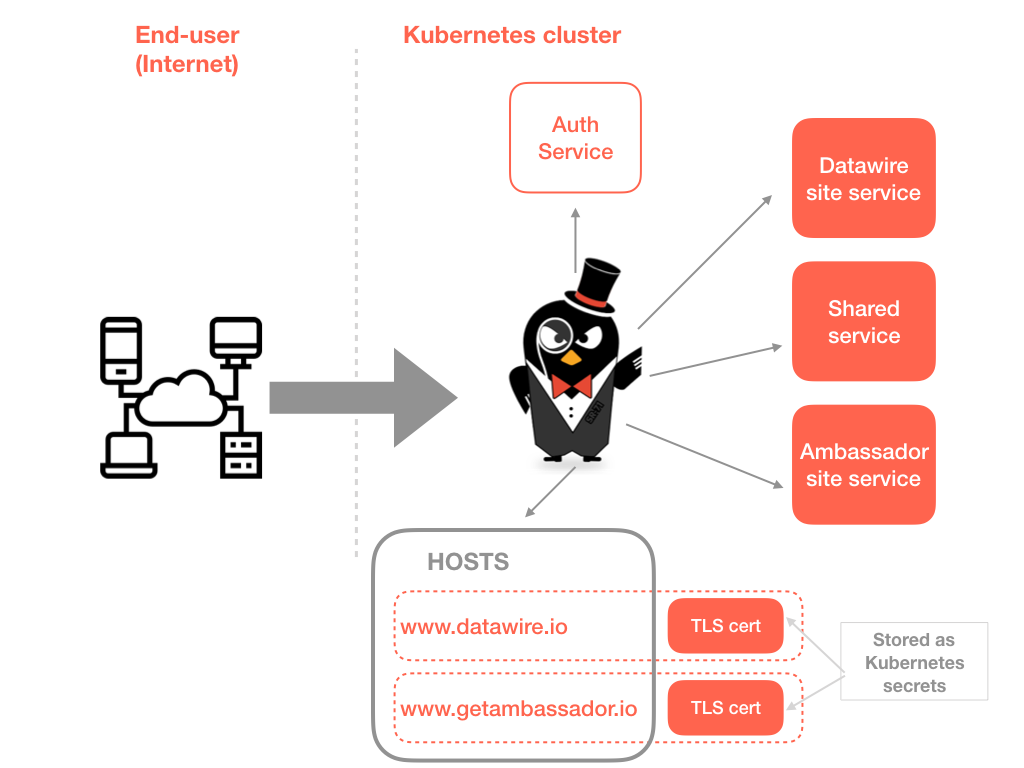
This article provides an insight into the creation of the Ambassador open source API gateway for Kubernetes, and discusses the technical challenges and lessons learned from building a developer-focused control plane for managing ingress or ‘edge’ traffic within microservice-based applications. Key Takeaways Developed by Datawire, Ambassador is an open source API gateway designed specifically for use with the Kubernetes container orchestration framework. At its core, Ambassador is a control plane tailored for edge/API configuration for managing the Envoy Proxy “data plane”.

Envoy itself is a cloud native Layer 7 proxy and communication bus used for handling “edge” ingress and service-to-service networking communication. This article provides an insight into the creation of Ambassador, and discusses the technical challenges and lessons learned from building a developer-focused control plane for managing ingress traffic within microservice-based applications that are deployed into a Kubernetes cluster. Migrating Ambassador to the Envoy v2 configuration and Aggregated Discovery Service (ADS) APIs was a long and difficult journey that required lots of architecture and design discussions, and plenty of coding, but early feedback from the community has been positive.

Source: infoq.com
Share :
comments powered by Disqus

Related Posts

Server Name Indication (SNI) Support Now in Ambassador

Server Name Indication (SNI) Support Now in Ambassador

We’ve discussed many interesting use cases for SNI support within the edge proxy/gateway with both open source and commercially supported users of Ambassador. In a nutshell (and with thanks to Wikipedia), SNI is an extension to the TLS protocol which allows a client to indicate which hostname it is attempting to connect to at the start of the TCP handshaking process. This allows the server to present multiple certificates on the same IP address and TCP port number, which in turn enables the serving of multiple secure websites or API services without requiring all those sites to use the same certificate.

Read More
Docker and Kubernetes in high security environments

Docker and Kubernetes in high security environments

This is brief summary of parts of my master’s thesis and the conclusions to draw from it. This medium-story focuses on containerized application isolation. The thesis also covers segmentation of cluster networks in Kubernetes which is not discussed in this story.

Read More
A Crash Course For Running Istio

A Crash Course For Running Istio

At Namely we’ve been running with Istio for a year now. Yes, that’s pretty much when it first came out. We had a major performance regression with a Kubernetes cluster, we wanted distributed tracing, and used Istio to bootstrap Jaeger to investigate.

Read More