Poseidon-Firmament Scheduler – Flow Network Graph Based Scheduler

Poseidon-Firmament Scheduler – Flow Network Graph Based Scheduler

  • February 8, 2019
Table of Contents

Poseidon-Firmament Scheduler – Flow Network Graph Based Scheduler

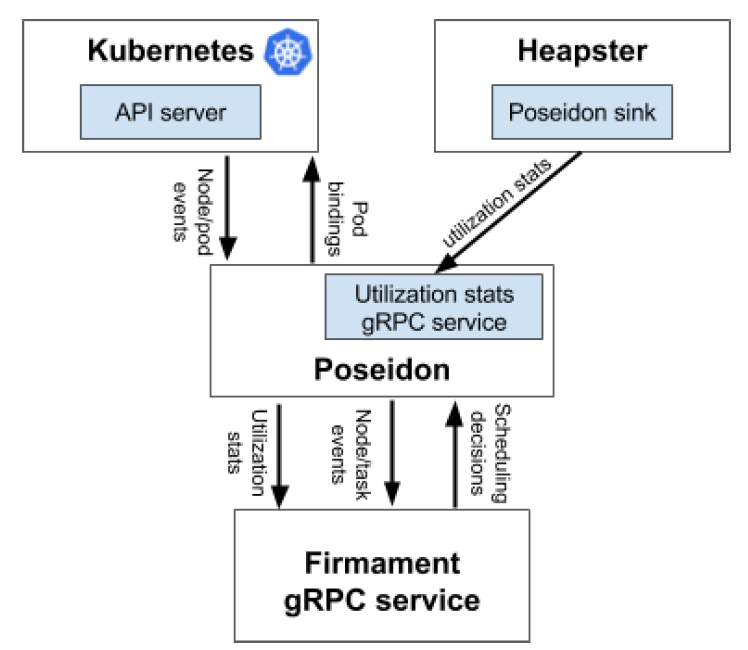
In this blog post, we briefly describe the novel Firmament flow network graph based scheduling approach (OSDI paper) in Kubernetes. We specifically describe the Firmament Scheduler and how it integrates with the Kubernetes cluster manager using Poseidon as the integration glue. We have seen extremely impressive scheduling throughput performance benchmarking numbers with this novel scheduling approach.

Originally, Firmament Scheduler was conceptualized, designed and implemented by University of Cambridge researchers, Malte Schwarzkopf & Ionel Gog. At a very high level, Poseidon-Firmament scheduler augments the current Kubernetes scheduling capabilities by incorporating novel flow network graph based scheduling capabilities alongside the default Kubernetes Scheduler. It models the scheduling problem as a constraint-based optimization over a flow network graph – by reducing scheduling to a min-cost max-flow optimization problem.

Due to the inherent rescheduling capabilities, the new scheduler enables a globally optimal scheduling environment that constantly keeps refining the workloads placements dynamically.

Source: kubernetes.io
Share :
comments powered by Disqus

Related Posts

Server Name Indication (SNI) Support Now in Ambassador

Server Name Indication (SNI) Support Now in Ambassador

We’ve discussed many interesting use cases for SNI support within the edge proxy/gateway with both open source and commercially supported users of Ambassador. In a nutshell (and with thanks to Wikipedia), SNI is an extension to the TLS protocol which allows a client to indicate which hostname it is attempting to connect to at the start of the TCP handshaking process. This allows the server to present multiple certificates on the same IP address and TCP port number, which in turn enables the serving of multiple secure websites or API services without requiring all those sites to use the same certificate.

Read More
APIServer dry-run and kubectl diff

APIServer dry-run and kubectl diff

Declarative configuration management, also known as configuration-as-code, is one of the key strengths of Kubernetes. It allows users to commit the desired state of the cluster, and to keep track of the different versions, improve auditing and automation through CI/CD pipelines. The Apply working-group is working on fixing some of the gaps, and is happy to announce that Kubernetes 1.13 promoted server-side dry-run and kubectl diff to beta.

Read More
Reaching for the Stars with Ansible Operator

Reaching for the Stars with Ansible Operator

In this post I will show you how to use Roles published to Ansible Galaxy as an Operator to manage an application in Kubernetes. Reusing a Role in this way provides an example of how to create an Operator that simply installs an application with the flexibility to expand and customize the behavior organically as requirements dictate. I will leverage both the Ansible Operator and the k8s module to demonstrate how you can use Ansible to create Kubernetes native applications.

Read More